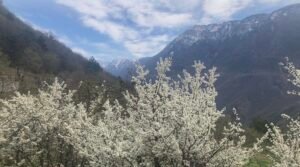
Just beyond the hermitage of San Colombano, a steep little road winds its way upwards. We check that no cars are coming and head up it. It is early April, and here in Vallarsa the leaves on the trees are still just tiny buds, tightly curled up. We have come to speak with Luigina Speri, a guest at our festival Il Canto della Terra, which will take place in Rovereto and neighbouring areas on 7, 8, 9 and 10 May. With her, we will explore the uses of wild herbs: on the morning of 9 May, she will lead us in a workshop on foraging and identification in the mountains, followed by a communal cooking session at the Rosmini parish hall, to learn how to use these plants in our dishes.
Luigina has been working in this sector for years, bringing together a variety of experiences that are deeply interconnected. Through her farm, Al Massarem, she has championed organic farming practices, combining them with an educational initiative aimed at children through a summer camp. Over the years, she has also devoted herself to processing medicinal herbs, both wild and cultivated, developing a practical understanding of their uses.
Aldo, Luigina’s husband, opens the gate for us. A blue-eyed dog pops out from between his legs and comes running towards us, greeting us excitedly. Luigina motions us to walk down a few steps towards the garden, where lavender, helichrysum, sage and rosemary grow – the raw materials of her work. She tells us about her collaboration with Maria, one of her colleagues, and the creams, ointments, essential oils and infused oils they make.
I ask her where her knowledge comes from, where her connection to the land stems from. Her answer is direct and immediate. Her father. As a child, she watched him treat himself with herbs; her mother, on the other hand, “was all for chemicals”, she says with a smile. In her account, there is a sense of continuity: the practical knowledge inherited and passed down, but also the realisation that this alone is not enough – that one must continue to learn.”
“My parents taught me the practical side of things. I learnt how to sow, plant, hoe, clean the barn, spread manure, cook, make tagliatelle, make gnocchi and make polenta. And what else did I learnt? I learnt respect. I learnt to eat well. My mother was a good cook. I’ve improved my cooking even further by reading and taking courses. You have to keep learning; you can’t stand still. So, course after course. Both in biodynamics and in cooking. You have the basics, but then you have to keep learning.”
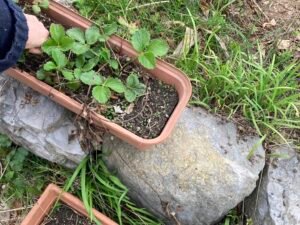
We head down to the vegetable patch. The peas, garlic and leeks are starting to sprout, and even the artichokes, though they’ll come later – “but they’re tiny”.
To keep learning, she says, you also need a network.
“You need a support network. Because how else can you manage? You’re out of the loop, you’re on your own. We’re not alone. We’re not alone. I have friends. For example, I have a friend from whom I’ve learnt. She’s given me loads of tips. Because I need the knowledge of the twentieth century here, but I also need other things. You can’t just be a farmer for the sake of it… you can’t. You have to pick up a book, talk, exchange ideas with other people. I have my parents’ knowledge, but it’s twentieth-century knowledge.”
Luigina’s father was a farmer. A miner by necessity, a carpenter by vocation. After an accident left him blind in one eye, he returned to the fields.
“A carpenter must have two eyes. Because in the old days, they didn’t have lasers, they relied on their eyes. So he went back to the fields. We were sharecroppers for Count Bossi Fedrigotti for a few years, and there I learnt from my great teacher, who was my dad, and my great teacher, who was my mum, how to work the land.
It wasn’t really my intention to carry on farming, to be honest. But at a certain point in my life, I needed to get away from the city. It was starting to feel a bit stifling. And when I saw the land… there’s a very intimate bond between us. It beckons me.
When she talks about the land, Luigina uses words that evoke the body. She describes it as a belly: something that digests, or that cannot digest.
“I try to put as few chemicals as possible into the soil. Because the soil cannot digest chemicals. It digests manure – it digests that – it digests compost, it digests everything that comes from it.”
I ask her what she thinks the state of agriculture in Trentino is today.
“There’s too much monoculture. Do you know what they used to tell me? That when you came down from Brentonico in the 1950s and turned around, you’d see all the terraces, each a different colour. On one there was wheat with poppies, on another there was maize. Every terrace had a colour. The vines, though—not as many vines as there are now. I practise crop rotation. Last year I planted the peas over there. This year I’m planting them here. I’ve planted the onions here. I rotate the crops because otherwise the nutrients and minerals in the soil get depleted, and that’s what monoculture does. Given how the situation is evolving worldwide, it’s absolutely vital now to have food security.”
Practising this kind of farming takes time, it takes patience. Patience is also needed when dealing with the incursions of an animal that’s very common here: the deer.
“There are so many of them. Every now and then you see them passing through the woods. Sometimes as many as twenty. Once I went out of the house in winter and saw a strange animal. I said, ‘Who are you?’ It looked at me – you know, it was this tall. So I said, ‘How could you eat my crops?’ Then it got a bit scared, the fence was lower, so it jumped out. I count on these vegetables, I don’t buy them at the supermarket, not me.”
All sorts of herbs and plants grow around us; as well as the cultivated ones, many are wild: borage, milk thistle, radicchio—they seed themselves.
“Plants hardly ever get sick here. And there are natural remedies, right? They take a bit more time, a bit of patience. There’s nettle macerate. There are lots of things you can do, it just takes more time, more dedication. You devote more time to yourself and to nature. When you pick up the hoe, you’re right there. You’re there to tend to things. It’s about care, isn’t it? It’s the care you have to put in. In life, you have to put care into things. Even into yourself, which is a bit harder. You have to care for what you do. Then it turns out well. Food. The dedication to food, to the home, too. To friendships. Devoting time. What else do we do? We’re always alone. We need others, a bit of a chat. To be with others.”
“How does your yoga practice fit into all this?”
“Well, yoga is tradition. And this is tradition. Yoga helps you to be with yourself. Here you are with yourself. There is no difference between you and the plant and the earth. It’s just you. It’s always you. The love you bring to doing things. That is what matters. Being, being. You can’t come here and teach yoga without being present. You can’t stand here hoeing, tending to the plants, without being present. We can call it ‘here and now’. We can call it that. Later we can give it all the names we like, but that’s what it is: being present. In this society, you’re less and less present. But that’s how it is, and that’s fine, you need to be adaptable also in that sense. As for yoga… well, yoga helps my back pain go away, this makes it come back, so they’re two things that go hand in hand.”
We stop recording and head back to the kitchen. Luigina shows us one of her creams and invites me to rub a little onto my hands. The scent unfolds on my skin: lavender, calendula, St John’s wort oil.
We look forward to seeing you at Luigina’s workshop on 9 May, meeting at 9.30 am at the Vanza di Trambileno car park.
The full festival programme is available here