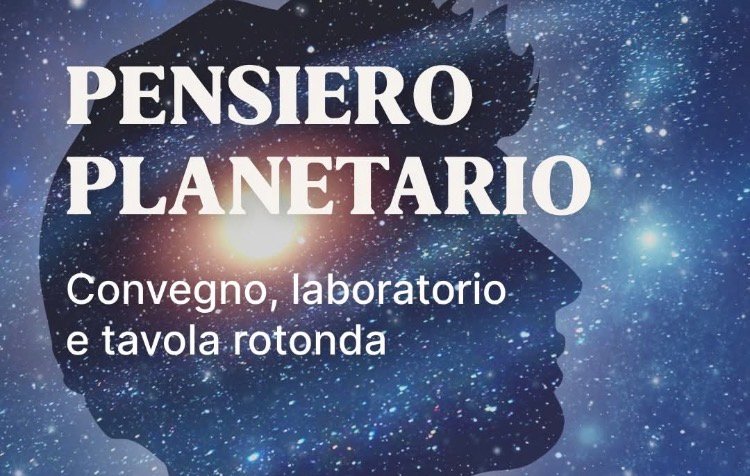
Retrospective on the event “Planetary Thought”, part of the festival Song of the Earth (Rovereto, October 11, 2025)
“Planetary Thought” is a one-day event organized within the Song of the Earth festival, dedicated to exploring the relationship between technology, artificial intelligence, and the climate crisis. We spoke with Ludovico Rella, the event’s creator and organizer.
Q: How did the event come about, and what themes does it address?
The event emerged from the broader themes of the festival, which revolve around climate change in a broad sense. We decided to dedicate an entire day to the relationship between technology, artificial intelligence, and environmental impact.
Over the past three to four years, AI has become a leading sector and has quickly proven to be a technology with enormous energy demands. Running language, generative, and graphical models requires infrastructure on a planetary scale. These infrastructures consume significant amounts not only of energy but also of water.
This raises important questions: what impact will the growing energy demand have on the ecological transition? The shift from fossil fuels to renewable energy was already a complex challenge, and the rise of AI adds further pressure.
At the same time, however, AI technologies also offer promising possibilities. They can contribute to the ecological transition, for instance by producing highly accurate climate models, simulations of global warming or sea-level rise, and even full-scale digital twins of the planet. AI is also being used in areas such as modeling plasma flows in fusion reactors, which could support new forms of clean energy.
The idea behind the event was therefore to hold these two dimensions together: on the one hand, a critical perspective on the environmental costs of AI; on the other, an openness to its potential future applications.
Q: You are a postdoctoral researcher in geography at Durham. How did you come to work at the intersection of these fields, and what can geography contribute?
My path has been somewhat indirect: I come from political science, which I studied in Florence and later in Lund, Sweden. I turned to geography because it is a deeply interdisciplinary discipline, almost “rebellious” toward traditional academic boundaries.
Geography allows us to analyze social phenomena from multiple perspectives at once. In my case, I was already interested in the social impact of technologies during my master’s studies. Geography provides both theoretical and methodological tools to understand how technologies always develop in space, within material networks and global relations.
For example, every device we use – smartphones, computers – is the result of global production chains: mineral extraction, component manufacturing, logistics, and distribution. Studying these chains allows us to connect our everyday experience to a global economy shaped by divisions of labor and inequality.
Another key aspect concerns digital infrastructures. When we use tools like ChatGPT, we activate a complex network of data centers distributed around the world. These systems rely on vast amounts of globally collected data and on a division of labor that includes, for example, content moderation – often carried out in countries of the Global South under critical working conditions.
Geography is concerned precisely with this: the relationship between everyday life and global systems, between technology, economy, and space. This interdisciplinary approach makes it possible to address complex phenomena in a more nuanced, but also more accessible, way.
Q: Critical geography challenges the idea of a “technological solution” to the ecological crisis. How does this debate relate to your research?
This kind of approach is, first of all, a way of asking questions rather than providing definitive answers. It involves deconstructing the idea that technology can be a neutral solution.
A useful reference here is Michel Foucault and the concept of “problematization”: every solution generates new problems, and every solution works for some, but not for others. This implies a fundamental awareness of structural inequalities.
In the case of AI, the goal is not simply to criticize it, but to question the idea that it can represent the solution to the ecological crisis. Climate change and the energy transition are political and social problems; they cannot be reduced to purely technical issues.
Every technology develops within specific social conditions. For this reason, it is essential to ask: what kind of society are we building as we integrate these technologies? Which outcomes are desirable – and for whom?
In my research, for example, I look at the centralizing nature of contemporary AI: large data centers, powerful corporations, enormous energy consumption. But this is only one possible model. We could imagine alternative forms of AI: smaller, less energy-intensive, more decentralized, and deployable on local devices.
There are already research networks, particularly at the European level, exploring these possibilities and reflecting on the role of the public sector. One of the main risks, in fact, is that control over technology increasingly shifts to large private companies.
Q: Let’s talk about digital twins. What are they, and what opportunities do they offer in climate modeling?
Digital twins are technologies that aim to create replicas of real-world systems, but there is no single, fixed definition. They can operate at very different scales: from the human body to smart cities, to the global climate or the oceans.
In recent years, they have become a key area of application for machine learning. Projects such as NVIDIA’s Earth-2 or the European initiative Destination Earth aim to build a digital twin of the planet. The goal is to integrate climate, economic, and social data in order to simulate complex scenarios.
During the workshop, we worked with researchers from the Barcelona Supercomputing Center on these topics through participatory design activities.
At the same time, it is crucial to maintain a critical perspective: data is never neutral. It is always partial, situated, and tied to specific contexts and interests. In building digital twins, we must ask which perspectives are included and which are excluded.
When working at a planetary scale, it is essential to avoid a Eurocentric approach dominated by the Global North. It is not simply a matter of “integrating” local knowledge into a dominant framework, but of questioning the very ways in which knowledge is produced.
The climate crisis is also the result of specific knowledge systems developed in the Global North. Assuming that intensifying those same paradigms will lead to different outcomes risks being an illusion.
*
As Rella’s words suggest, the challenge is not to find a technological solution to the ecological crisis, but to rethink the way in which technology, society, and the environment are intertwined. In this sense, “Planetary Thought” has captured the complexity of a rapidly changing field, marked by both technological promises and material limitations.
Rather than providing definitive answers, the event opened up a space for shared reflection: on the role of artificial intelligence, on the models of development we should support and, above all, on the ways of living together that we are willing to envisage.